

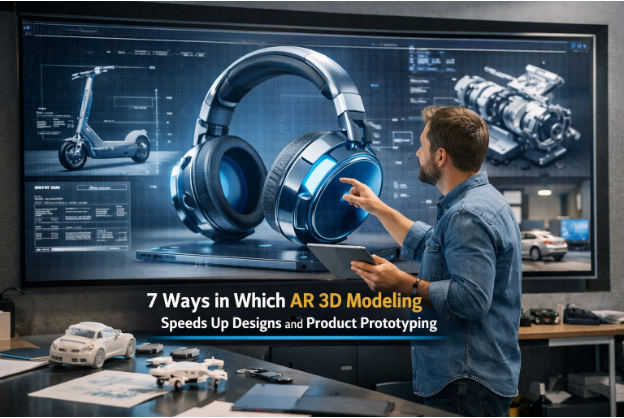

In the speedy product development of today, speed, accuracy, and innovation are among the major ingredients for winning. Traditional ways of prototyping, including physical mockups, cycles of multiple iterations, and review, can bring down the pace considerably.
This is also where AR 3D modeling is making a strong impact, changing the way teams can actually perceive concepts, perceive the design, and speed up product launches. By combining augmented reality with digital modeling at a higher level, businesses can reduce complications in prototyping, cut costs, and enhance precision in design.
Professional 3D modeling services play a very important role in providing high-quality AR-compatible models that bring ideas to life in immersive and interactive ways, as companies increasingly adopt digital-first workflows.
The following are seven ways in which AR-based modeling quickens design and prototyping processes across modern industries.
1. Real-time Visualization Supports an Early Concept Evaluation
Perhaps one of the main advantages of AR 3D modeling is to visualize a digital design directly placed into a real-world environment. Perhaps context like that helps designers assess a design’s scale, fit, and usability long before any physical prototypes are created.
Teams can:
- Place digital models on a desk, in a showroom, or on the factory floor
- Measure products for height, depth, and ergonomics in real time
- To identify design flaws at the early concept phase
It can make early-stage decisions more accurate and much quicker by removing the guesswork.
2. The Number of Physical Prototypes Needed is Reduced
For traditional prototyping, many iterations are required; physically making the process is more costly and increases the time taken for development. AR provides a virtual alternative in which to simulate physical products with high accuracy.
Businesses can, through AR-supported 3D modeling services:
- Test variations virtually before committing to fabrication.
- Compare several design options in real-time.
- Identify changes without wasting the material.
3. Immersive Collaboration Accelerates Design Reviews
Where AR will let designers, engineers, clients, and manufacturers together review the prototype in an immersive virtual environment, instead of just looking at renders or drawings, each person will view the model as if it were physically present.
This speeds up reviews by:
- Clear interpretation of features and dimensions enabled.
- Enables faster decision-making.
- Smooth the misunderstandings with flat visuals.
Specially useful for large teams or remote collaborators, the review sessions based on AR will help to keep alignments intact throughout the development cycle.
4. Increasing Precision through True-to-Scale Virtual Prototypes
Scale-related errors align products to delay development and add unnecessary costs. AR removes this issue entirely as it represents models at correct life-sized measurement dimensions. AR lets you walk around, rotate, and even interact with the virtual prototype to investigate every detail.
To-scale AR 3D modeling supports:
- Better ergonomic analyses
- Smarter material and manufacturing decisions
- Early identification of spacing, clearance, and functional problems
Since such an accurate model is available right from the very beginning, this whole design process is far more efficient and predictable.
5. Allow for Faster Iterations, Changes in Real Time
One of the strongest suits of AR is speed: a designer can make changes to a model digitally and then see an updated version out in the physical environment-the opposite of traditional prototyping.
Rapid iteration allows for:
- Fast validation of design changes.
- Variants of model comparison in real time.
- Smoother refinement of shapes, textures, and components.
Acceleration minimizes bottlenecks and ensures that development momentum is not lost at any time, with unnecessary delays.
6. Interactive AR Experiences for Greater User Testing
Testing with real users is one of the most important techniques in understanding how a product will work in the field. The main benefits of AR are that it makes this a lot more effective and considerably faster by letting users interact with a virtual version of the product.
With AR-enhanced prototypes, testers can:
- Simulate real use cases.
- Perform feedback from an ergonomics and usability perspective.
- Experience functionality, not waiting for a physical build.
This, if derived early, would help refine the design decisions before manufacturing starts and avoid costly changes afterwards.
7. Smoothening Communications between Design and Manufacturing Teams
Seamless communication is needed when bringing a product from design to production. AR visuals make manufacturing teams far better understand the designer’s intent, thus giving an accurate translation of concepts into physical products.
AR reinforces communication by:
- Providing clear visual references.
- It reduces ambiguities relating to dimensions or assembly.
- Anticipating tooling and material requirements for plants.
AR facilitates this chasm between creative design and everyday manufacturing demands by way of specific 3D modeling services.
Final Thoughts
AR 3D modeling has become a tool of high demand for industries moving toward more agile methods of product development; it quickens design, cuts costs, and generally helps in improving the quality of a product. Being able to view prototype presentations in real-world environments, conduct immersive reviews, test out variations fast, and refine ideas confidently, this taken together equates to a high competitive advantage for the teams.
All this comes together with experienced 3D modeling services to let companies realize the full potential of AR-driven workflows: faster times to innovate, smarter decision-making processes, and successful product launches. In other words, AR will be one of those transformative forces shaping the future of design and prototyping as the technology continues to move on.