

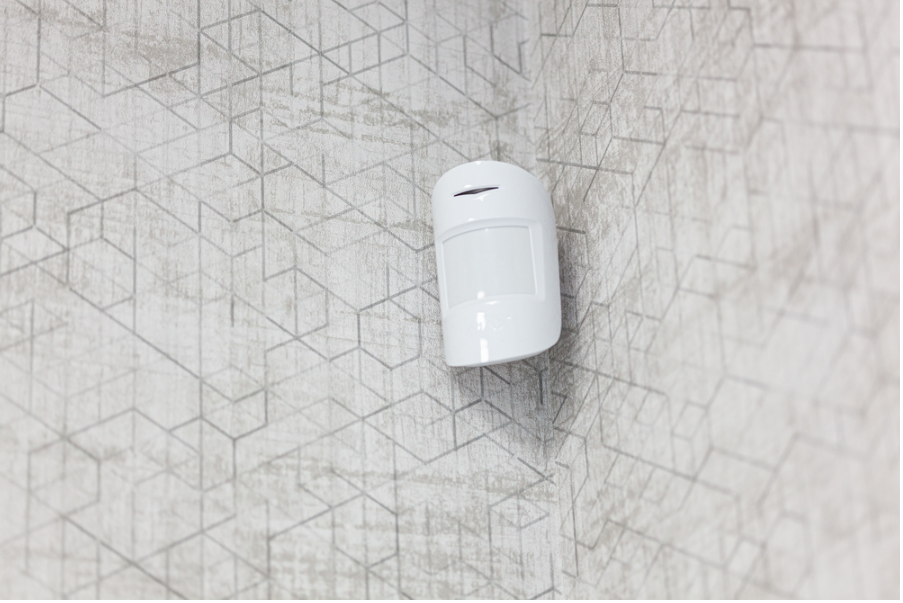

Every entry-level home security system comes with contact sensors for first-floor windows and doors. You might not get a sensor for every window, but you could order extra sensors if you wanted them. Here is the question: do you need additional motion sensors if all of your windows and doors are equipped with contact sensors?
Technically, no. You do not need any kind of sensor to protect your home against burglary or other crimes. But as long as you are investing in a home security system, why not maximize the protection you get for every dollar you spend?
It’s a good idea to have both contact and motion sensors in play. Before explaining why, let us talk briefly about a contact sensor. It is a two-piece unit installed to protect a window or door. As long as the two pieces remain in contact, they complete a circuit. But once contact is broken, so is that circuit. A broken circuit sends an alert indicating that a door or window has been opened.
Useless When Glass Is Broken
Contact sensors work well enough for their intended purpose, but they are useless if a thief decides to break the glass and climb through. If the window pane is never physically opened, contact is never broken. A thief can still enter your home without triggering an alert.
Vivint Home Security sells both kinds of sensors for windows: contact and broken-glass sensors. But equipping every first-floor window in your home with a broken glass sensor could push your budget to the limit. An alternative is to deploy a couple of motion sensors.
Where window sensors only provide protection for individual windows, a motion sensor can protect an entire room. You get more protection for the amount you spend. But there are other reasons to install motion sensors alongside your contact sensors, including redundancy.
Multiple Layers Creates Redundancy
Installing both contact and motion sensors creates two layers of security. Every layer adds redundancy. Why is that important? Because equipment fails, humans make errors, and thieves find workarounds. Redundancy overcomes mistakes and equipment failures to maximize protection.
The contact sensor’s biggest weakness is the fact that it is binary. In other words, it only protects against a single and specific event: a window or door being opened. A motion sensor can send an alert if:
- A window is broken.
- A window is opened.
- Someone climbs through the window.
- A person is wandering around the living room.
A strategically placed motion sensor provides a ton of protection, covering an entire room. Used in conjunction with contact and broken glass sensors, they can instantly alert a homeowner or remote monitoring center that unauthorized intrusion has taken place.
Modern Technology Is Much Better
Homeowners have traditionally been wary of motion sensors because they can easily trigger false alarms. But modern technology is so much better than what the industry offered just a decade ago. Today’s motion sensors are capable of distinguishing between humans and animals, for example. They offer a wider range of sensitivity adjustments to prevent false alarms.
Furthermore, modern home security systems allow homeowners to deactivate motion sensors while keeping everything else armed and ready to go. This is important in the sense that temporarily disabling motion sensors means not triggering false alarms when the family is home. The motion sensors only need to be active when the home is unoccupied.
In short, it is a good idea to install motion sensors even if your home is equipped with contact sensors for windows and doors. Motion sensors add redundancy – just in case.